
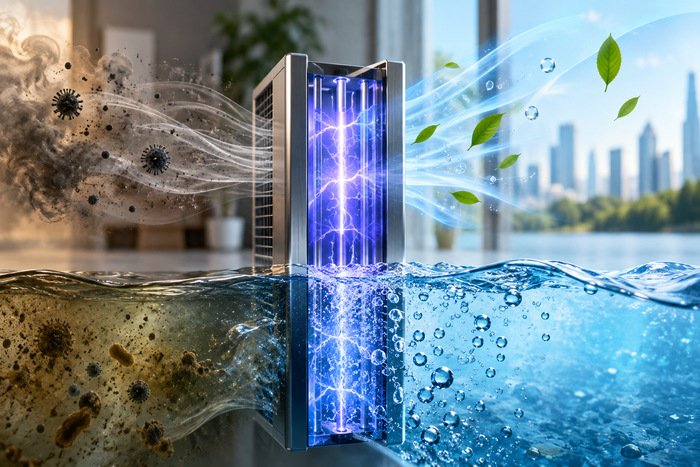
Cold plasma is emerging as an interesting technology for air purification, odor control, water treatment, and microbial reduction. Unlike conventional filtration, which mainly captures contaminants, cold plasma can generate reactive species that interact with pollutants and microorganisms.
Also known as Non-Thermal Plasma (NTP), cold plasma is already being studied and applied in environmental treatment, food processing, healthcare, industrial processes, and indoor air-quality systems.
But what exactly is cold plasma, how does it work, and what makes it different from technologies such as HEPA filtration, activated carbon, UV, or ozone?
What Is Cold Plasma Technology?
Plasma is sometimes described as the fourth state of matter, after solids, liquids, and gases.
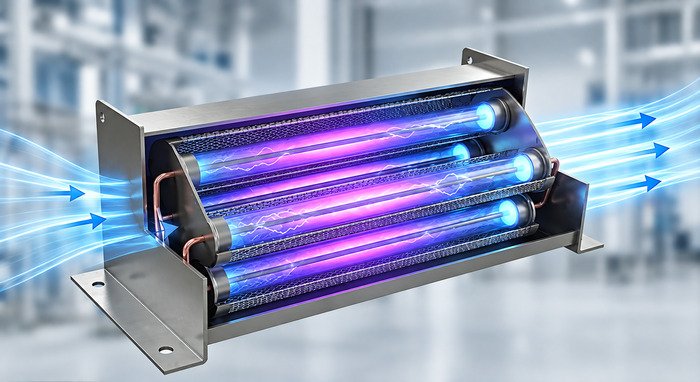
When sufficient energy is applied to a gas, some of its molecules become ionized, creating a mixture containing energetic electrons, ions, excited molecules, and other reactive species.
In thermal plasma, temperatures can become extremely high. Cold plasma is different.
In cold or non-thermal plasma, electrons can have high energies while the overall gas remains at a much lower temperature. This allows plasma chemistry to be used without heating the entire treatment environment to extreme temperatures.
This is one reason cold plasma has attracted attention for environmental applications.
In simple terms: Cold plasma uses electrical energy to create highly reactive species that can interact with contaminants in air or water.
How Does Cold Plasma Work?
A cold plasma system typically applies electrical energy to a gas such as air.
This creates a complex mixture of reactive components that may include ions, electrons, radicals and reactive oxygen and nitrogen species.
These species can then interact with pollutants.
The important difference is that cold plasma does not simply trap a contaminant inside a filter. Depending on the system and pollutant, plasma-generated reactions may transform or break down certain chemical compounds.
Different reactor designs can be used to generate cold plasma. One widely used approach is Dielectric Barrier Discharge (DBD), although DBD is not synonymous with cold plasma—it is one method of generating it.
Cold Plasma for Air Purification
One of the most promising areas for cold plasma is air treatment.
Research has investigated non-thermal plasma for the treatment of volatile organic compounds (VOCs), odors, microorganisms, and other airborne contaminants.
Unlike HEPA filtration, which primarily captures particles, cold plasma involves chemical and physical reactions with contaminants.
Potential applications include:
- HVAC air-treatment systems
- Commercial air purifiers
- Odor-control systems
- VOC treatment
- Hotels and offices
- Restaurants and smoking environments
- Waste and garbage areas
- Industrial air treatment
This does not mean cold plasma should replace every conventional filter. In many applications, it can make more sense as part of a multi-stage air-treatment system.
For example, particle filtration can remove dust and aerosols while another stage addresses gaseous pollutants.
Can Cold Plasma Remove Odors and VOCs?
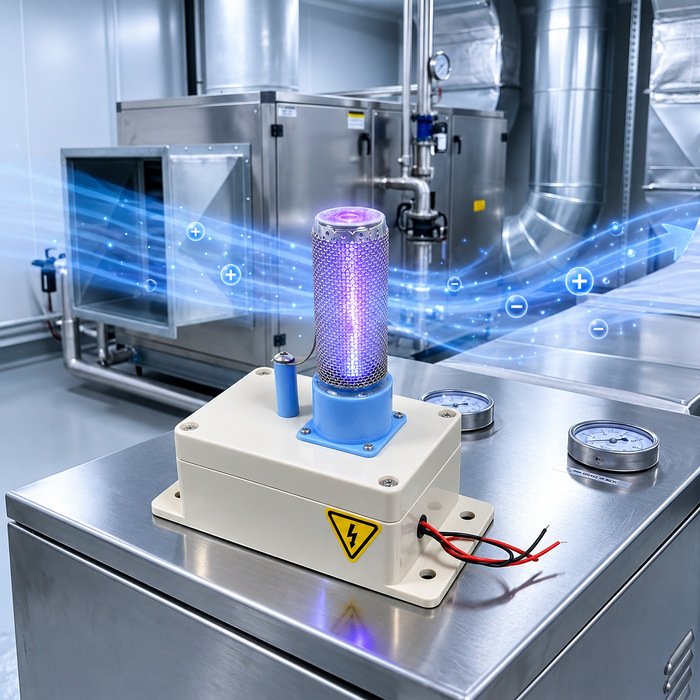
Cold plasma has been studied for the decomposition of various VOCs and odor-causing compounds.
This makes it particularly interesting for Darbune applications where traditional particle filtration alone cannot solve the problem.
However, performance depends on the pollutant, concentration, airflow, reactor design, energy input and contact time.
Cold plasma should therefore not be marketed as a technology that automatically removes every odor or VOC.
Another important consideration is by-products. Depending on reactor design and operating conditions, plasma treatment can generate compounds such as ozone or other reaction products.
For equipment intended for occupied spaces, emissions and independent testing are therefore important.
Learn more about Why Some Air Purifiers Remove Dust but Not Odors?
Cold Plasma for Water Treatment
Cold plasma is not limited to air.
Researchers are also studying plasma-activated water and direct plasma treatment for water purification, microbial inactivation, and degradation of certain organic contaminants.
When plasma interacts with water, reactive oxygen and nitrogen species can be generated in or transferred into the liquid. These reactive species can participate in chemical reactions with microorganisms and some contaminants.
Potential applications being researched include wastewater treatment, industrial water treatment, microbial control, and degradation of certain persistent organic pollutants.
This is particularly interesting because treatment can be produced using electricity and gas, potentially reducing dependence on continuously adding conventional treatment chemicals in some applications.
However, cold plasma water treatment is still highly application-dependent and should not be presented as a universal replacement for established water-treatment processes.
How Is Cold Plasma Different From Other Technologies?
The easiest way to understand cold plasma is to compare its basic function with familiar technologies.
| Technology | Primary Function |
|---|---|
| HEPA | Captures airborne particles |
| Activated Carbon | Adsorbs odors and certain gaseous pollutants |
| UV-C | Uses ultraviolet radiation for microbial control |
| Ozone | Uses ozone as a strong oxidizing agent |
| Cold Plasma | Generates multiple reactive species through electrical discharge |
The key advantage of cold plasma is therefore not simply “better filtration.”
It represents a different treatment mechanism.
Advantages of Cold Plasma Technology
Cold plasma has several characteristics that make it interesting for future air and water-treatment systems.
It can operate at relatively low bulk gas temperatures, can generate reactive chemistry without conventional high-temperature processes, and can potentially act on several categories of contaminants.
Systems can also be compact and integrated into HVAC equipment or other treatment devices.
Perhaps most importantly, cold plasma offers opportunities to combine electrical treatment with conventional filtration, rather than relying on one technology to solve every indoor-air or water-quality problem.
The Future of Cold Plasma
Cold plasma is promising, but the performance of one plasma device cannot automatically be assumed for another.
Reactor design, electrical characteristics, airflow, pollutant concentration, treatment time, emissions, and safety all matter.
For Darbune, cold plasma is particularly interesting as a next-generation technology for air, odor, VOC, and potentially water-treatment applications, alongside established solutions such as activated carbon, filtration, UV, and ozone.
At Darbune, we continue to explore emerging environmental technologies and how they can be applied responsibly to real-world air and water-quality problems.