For persistent waste odour, choose a treatment intended for garbage-room conditions rather than relying on fragrance alone. Specialist formulations and suitable gas-filtration systems can address particular odours. Selection should follow a review of the source, airflow, waste load and maintenance requirements.
Growing populations and expanding cities are putting more pressure on waste collection and storage. The World Bank identifies population growth, urbanisation and increased consumption as drivers of rising municipal waste volumes. World Bank: What a Waste
Inside residential towers, hotels and office buildings, this challenge has a familiar smell. Food waste accumulates between collections, bags leak and odours develop around bins and chute openings. When the smell reaches a corridor or lift lobby, people start asking management to act.
An ordinary air freshener may change how the area smells briefly. Lasting garbage room odour control requires attention to the source, airflow and equipment used.
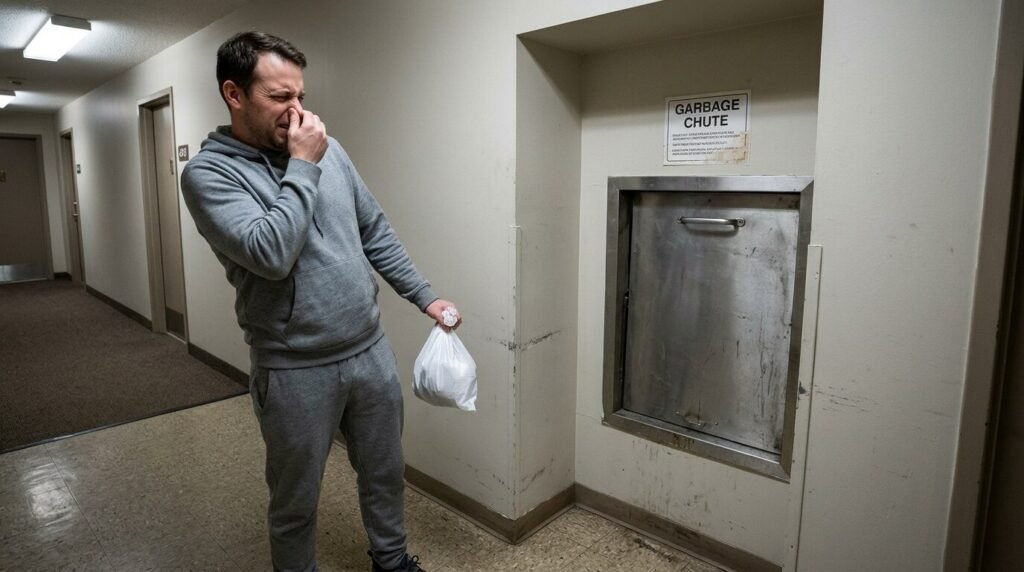
When the garbage room affects the whole building
Residents expect shared spaces to feel clean. Hotel guests expect the same from service corridors and areas near their rooms. Persistent waste odour can undermine that experience, even when housekeeping teams clean regularly.
For building managers, repeated complaints also consume time. Staff inspect the area, clean again and spray another product. If the cause remains, the cycle continues.
The first step is to inspect waste containers, leaked liquids, drains and chute residue. Check collection schedules and ask the maintenance team to review ventilation. These basics establish what treatment equipment needs to address.
Ordinary air fresheners mainly add fragrance
A conventional air freshener introduces a scent that can temporarily mask an unpleasant smell. It does not necessarily remove the compounds responsible for it.
In a busy garbage room, perfume may mix with waste odour rather than resolve the complaint. Increasing the spray frequency can leave the area smelling more strongly of both.
Not every air freshener is suitable for waste-storage areas. A product intended for a reception desk or washroom should not automatically be selected for a room receiving food waste throughout the day.
For this application, management should ask what the product actually does, where it is intended to be used and what evidence supports its claims.
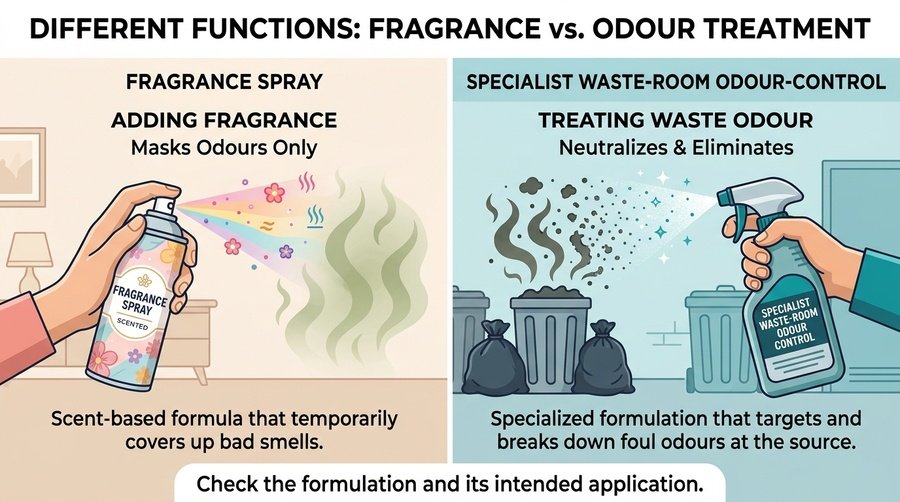
Specialist sprays offer a different approach
A purpose-designed trash room deodorizer may use a formulation intended to reduce particular odours rather than add fragrance. Depending on the product, it may act on source materials or interact with certain odour compounds.
Application matters. A surface-treatment spray and a liquid approved for airborne diffusion are different products.
Specialist fragrance-free formulations can be considered where management wants odour treatment without adding a perfume scent. Ask for application instructions, safety information and performance evidence relevant to waste areas.
Some products are applied manually. Others work with automatic diffusers or misting equipment that deliver a controlled dose. Choose the formulation and device together; putting an unsuitable cleaner into a diffuser is not an acceptable substitute.
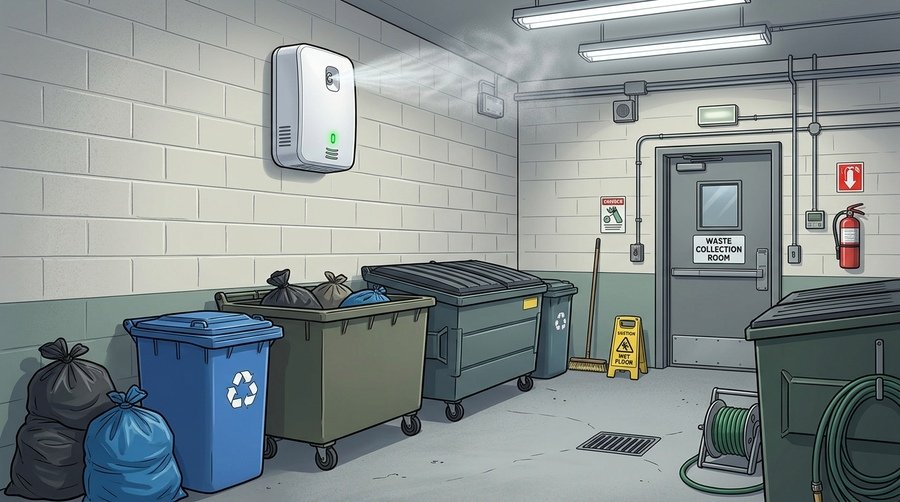
Spraying alone may leave the problem unresolved
A suitable spray can form part of the response, but fresh waste continues arriving. Air may also carry odour towards doors, corridors or the chute shaft.
Reducing the airborne odour load near its source can help limit spread. However, preventing movement through the building also requires attention to airflow and containment.
For recurring problems, specialist filtration can complement the spray programme.
Dedicated filters treat air through several stages
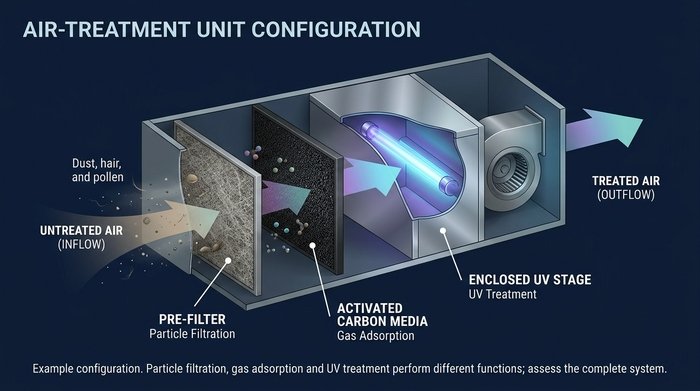
A powered garbage room filtration unit draws air through treatment stages selected for the application.
A pre-filter can capture larger particles and protect downstream components. Activated carbon or specialised gas-treatment media can adsorb selected odour compounds. The material must match the contaminants; a basic dust filter is insufficient for gaseous smells. California Air Resources Board: Odours and Gases
Some units include enclosed UV treatment for a separate microbial-control function. UV alone should not be presented as proof of odour removal.
For garbage room odor control, assess the complete unit: airflow, media quantity, placement and replacement requirements. Equipment should remain accessible for servicing and protected from wash water and moving bins.
Darbune’s guide explains how activated carbon removes odours.
Match the solution to each location
Ordinary air freshener
- Main purpose
- Adds fragrance to temporarily mask unpleasant smells.
- How it works
- Releases a scent into the air.
- Maintenance
- Requires refills or replacement.
- Role in an odour-control plan
- Changes the perceived smell without necessarily removing the compounds causing it.
Specialist odour-control spray
- Main purpose
- Reduces particular waste odours using a purpose-designed formulation.
- How it works
- Is applied to approved surfaces or dispersed through a compatible diffuser.
- Maintenance
- Requires refills, dosing checks and diffuser servicing where applicable.
- Role in an odour-control plan
- Supports cleaning and can complement filtration.
Dedicated garbage-room filtration system
- Main purpose
- Removes selected airborne odour compounds through filtration.
- How it works
- Draws air through multiple treatment stages, including suitable activated carbon media.
- Maintenance
- Requires filter replacement and equipment servicing.
- Role in an odour-control plan
- Provides ongoing air treatment alongside cleaning, waste collection and ventilation.
A garbage room deodorizer should be chosen around these conditions. Some buildings need treatment in both the main collection room and affected chute rooms.
Build a practical odour-control plan
Keep bin washing, waste collection and ventilation maintenance in place. Establish who will refill diffusers, replace filters and check performance.
Record where complaints occur before treatment, then revisit those locations afterwards. This gives management a clearer basis for judging results.
For towers, hotels and shared waste facilities, a practical plan may combine specialist fragrance-free treatment with dedicated filtration. Contact Darbune to discuss waste odour-control options suited to your building.