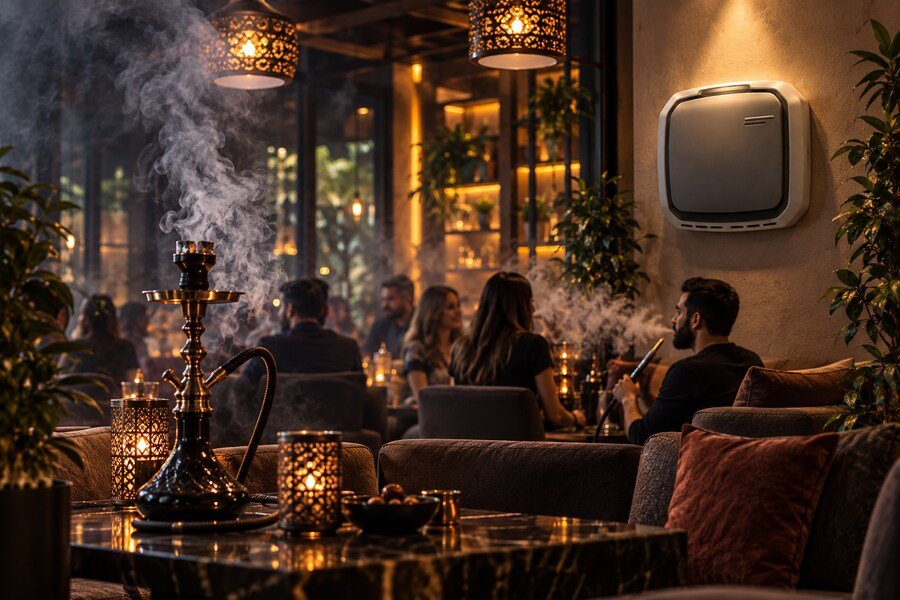
A shisha cafe can have a beautiful interior, comfortable seating, and good ventilation but if smoke remains in the air and the smell stays after closing time, it can quickly affect the experience of customers and staff.
The same problem can happen in restaurants serving shisha, cigar lounges, office smoking rooms, and homes where cigarettes or shisha are regularly smoked indoors.
This leads to an important question:
Will any air purifier remove cigarette or shisha smoke?
The answer is no.
Cigarette and shisha smoke contain both airborne particles and gaseous pollutants. HEPA filters are designed mainly for particles, while activated carbon and other gas-phase filtration media are used for odors and certain gaseous contaminants. For heavy-smoking environments, such as shisha cafes and cigar lounges, filter capacity, airflow, ventilation and smoke load are also important.
Smoke is a complex mixture. The visible particles are only one part of the problem. Cigarette and shisha smoke also contain gaseous pollutants and odor-causing compounds, which means one type of filter may not be able to handle everything.
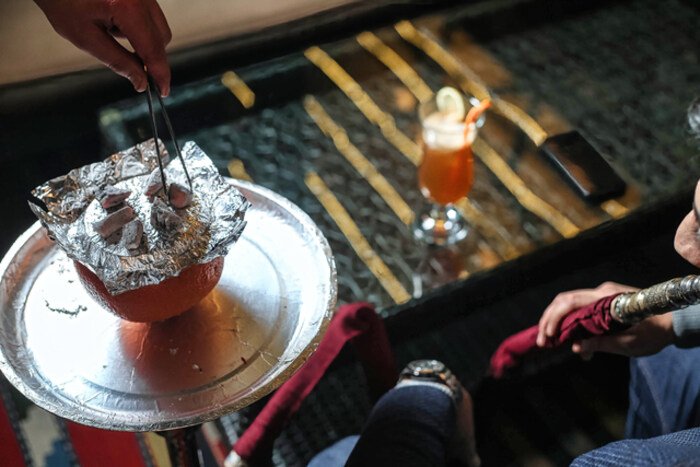
Why Is Cigarette and Shisha Smoke Difficult to Remove?
When people smoke indoors, the air purifier has to deal with two different challenges: airborne particles and gaseous pollutants.
Particle filters can capture much of the particulate matter carried in smoke. However, gases and odors require a different filtration approach.
This is why simply seeing the word “HEPA” on an air purifier does not necessarily mean the device is suitable for cigarette or shisha smoke.
Secondhand Smoke Affects Everyone in the Space
Smoke is not only a comfort or odor issue.
People around the smoker can also be exposed to secondhand smoke. This is particularly important in commercial environments where employees may spend many hours every day around customers who smoke.
According to the U.S. Centers for Disease Control and Prevention (CDC), there is no safe level of exposure to secondhand smoke. Exposure can cause serious health problems in adults and children.
For businesses, controlling smoke should therefore not be viewed simply as removing an unpleasant smell. Indoor air quality, ventilation, source control and appropriate filtration all need consideration.
Why Does the Smoke Smell Remain After Smoking Stops?
Anyone who manages a cigar lounge or shisha cafe may recognize this problem: customers have left, smoking has stopped, but the room still smells strongly the next morning.
Smoke-related pollutants do not simply disappear when visible smoke is gone.
Residues can settle on sofas, carpets, curtains, walls and other surfaces. With repeated indoor smoking, these materials can become significant sources of persistent odor.
The same thing can happen in a home or office where people regularly smoke indoors.
An air purifier can help control airborne contaminants, but it cannot be expected to remove heavy smoke residue that has already accumulated on surfaces over a long period. Cleaning and source control may also be necessary.

Does a HEPA Air Purifier Remove Cigarette and Shisha Smoke?
HEPA filtration can be very useful but it has a specific job.
HEPA filters are designed to capture airborne particles. Because smoke contains very small particles, effective particle filtration can significantly contribute to smoke control.
But HEPA does not remove gases in the same way a gas-phase filter does.
So if a purifier contains excellent particle filtration but very little gas-phase filtration, people may notice that visible smoke is reduced while the characteristic smoking odor remains.
Activated Carbon Can Help But Capacity Matters
Activated carbon is widely used for adsorbing odors and various gaseous contaminants.
This makes it particularly relevant when selecting an air purifier for cigarette, cigar or shisha smoke.
However, simply seeing “activated carbon filter” in a product specification is not enough.
A thin carbon sheet in a small household purifier and a substantial gas-phase filter designed for a heavy smoking environment have very different capacities.
The amount and type of adsorbent media, airflow through the filter, smoke concentration and operating time can all influence performance.
Activated carbon also has a finite capacity. Eventually, the media becomes saturated and needs to be replaced.
What About Other Air-Cleaning Technologies?
Commercial air-cleaning systems may use different technologies, including particle filters, gas-phase filtration, electrostatic filtration and other air-treatment methods.
Each has different strengths and limitations.
Ozone also requires special consideration. It should not be used as a continuous air-purification solution in occupied spaces. High-concentration ozone treatment is fundamentally different from normal air purification and requires appropriate safety procedures.
For a deeper comparison, read our guide on activated carbon vs ozone for odor removal
A Home Smoking Room Is Not a Shisha Cafe
This is one of the most important points when selecting an air purifier.
One person occasionally smoking in a room and 30 customers simultaneously smoking shisha in a busy cafe create completely different filtration loads.
A small portable purifier might help in a home or office application but become overwhelmed very quickly in a busy commercial smoking environment.
For cigar lounges, shisha cafes and restaurants serving shisha, factors such as room volume, number of smokers, operating hours, airflow, ventilation and filtration capacity become much more important.
Air Purification Does Not Replace Ventilation
An air purifier should not automatically be considered a replacement for proper ventilation or exhaust.
This is particularly important for restaurants, shisha cafes, cigar lounges and dedicated smoking areas.
Air purification can work alongside an appropriate ventilation strategy to reduce airborne particles, gases and odors, but the complete solution should be selected according to the actual space and smoking load.
So, Which Air Purifier Is Right for Smoke?
There is no universal answer.
Before choosing an air purifier for cigarette, cigar or shisha smoke, consider:
- How large is the space?
- How many people normally smoke at the same time?
- How many hours per day does smoking occur?
- What ventilation or exhaust system already exists?
- Does the system provide both particle and gas-phase filtration?
- How much gas-phase filter capacity is available?
- How frequently will the filters need replacement?
A purifier that works well in a home may not be suitable for a busy shisha cafe. Likewise, simply buying the largest machine does not guarantee good results if the filtration configuration is wrong for the pollutants being treated.
If you manage a commercial smoking area, read our guide to smoke smell removal in cigar lounges and shisha areas to learn more about controlling persistent smoke and odor.
Need Help Choosing a Smoke Air Purifier?
If you manage a shisha cafe, restaurant serving shisha, cigar lounge, smoking room, office, or home with a cigarette or shisha smoke problem, choosing the right equipment starts with understanding the space.
At Darbune, we can evaluate factors such as room size, smoke load, operating hours, existing ventilation and odor concerns to help identify a suitable air-cleaning solution.
Contact Darbune to discuss your cigarette or shisha smoke filtration requirements.
Frequently Asked Questions
A shisha cafe or cigar lounge needs filtration for both smoke particles and odors. A system combining effective particle filtration with sufficient activated carbon or other gas-phase filtration is usually more suitable than a basic air purifier. The right solution depends on the size of the space, number of smokers, ventilation, operating hours, and smoke load.
Most small residential air purifiers are not designed for the continuous smoke load of a busy shisha cafe or cigar lounge. Check the airflow, particle filtration, activated carbon capacity, filter replacement cost, and whether the unit is designed for heavy smoke environments.
Start by avoiding indoor smoking, increasing ventilation, and cleaning surfaces where smoke residue may have accumulated. An air purifier with effective particle filtration and sufficient activated carbon can also help reduce airborne smoke particles and odors.
For persistent cigarette smoke odor in a car, professional ozone treatment can be an option. Ozone treatment must only be performed when the vehicle is completely unoccupied, followed by proper ventilation before anyone enters the car again.
Ozone can be used for specialized treatment of persistent smoke odors, but it should not be used continuously in occupied spaces. High-concentration ozone treatment should only be performed in an unoccupied home or vehicle with appropriate safety procedures, followed by sufficient ventilation before people or pets return.