

Bananas have a very basic issue, as soon as the ripening starts, it goes fast.
A family buying green bananas at home could find that within a few days all of the bananas are yellow and/or overripe.
An importer or distributor dealing with thousands of boxes of bananas could face a completely different set of issues including shorter selling times, reduced product quality and increased waste.
These issues are particularly relevant in the UAE due to the fact that they import such a large quantity of bananas. In 2024, Ecuador, India and the Philippines alone exported approximately 235 million kg of bananas and plantains to the UAE.
The larger problem of food loss exists across many parts of the world. A study conducted on the banana supply chain in Gujarat, India showed that the total amount of post-harvest losses from harvest to ripening was 15.43%, including losses during transport, handling and ripening.
While these numbers do not represent the UAE specifically, they illustrate why managing bananas after harvest is so critical. (Journal of Horticultural Sciences)
Therefore, can controlling ethylene help bananas remain marketable for a longer period of time?

Why Do Bananas Ripen So Quickly?
Bananas continue to ripen after being harvested, and ethylene can accelerate this process. Ethylene, a naturally occurring plant hormone, is essential in the ripening process of bananas.
As bananas begin to ripen, the activity level of ethylene increases.
Additionally, exposure to ethylene produced by other fruits located near the bananas can also cause an increase in ripening.
This is beneficial when a distributor wishes to have bananas ripen prior to selling.
However, it can become problematic when ripening occurs too rapidly, such as during the storage and/or transport phases.
This is when ethylene management becomes important.
Can An Ethylene Absorber Slow The Ripening Process Of Bananas?
An ethylene absorber is designed to assist in reducing the concentration of ethylene in the atmosphere surrounding the bananas.
Through controlling the buildup of excessive amounts of ethylene, it can aid in creating conditions conducive to delaying premature ripening.
It does not prevent the banana from advancing beyond the green stage, nor does it inhibit its normal biological processes.
Variables such as:
- Temperature
- Humidity levels
- Ventilation systems
- Maturity levels
- Storage times
continue to play a factor.
Consider an ethylene absorber as only one component of effective banana storage management practices, as opposed to a definitive solution.
Commercial Ethylene Control Methods For Bananas
Importers, cold storage facilities, distributors of fresh fruits and vegetables and grocery stores are primarily concerned with the scale of operations.
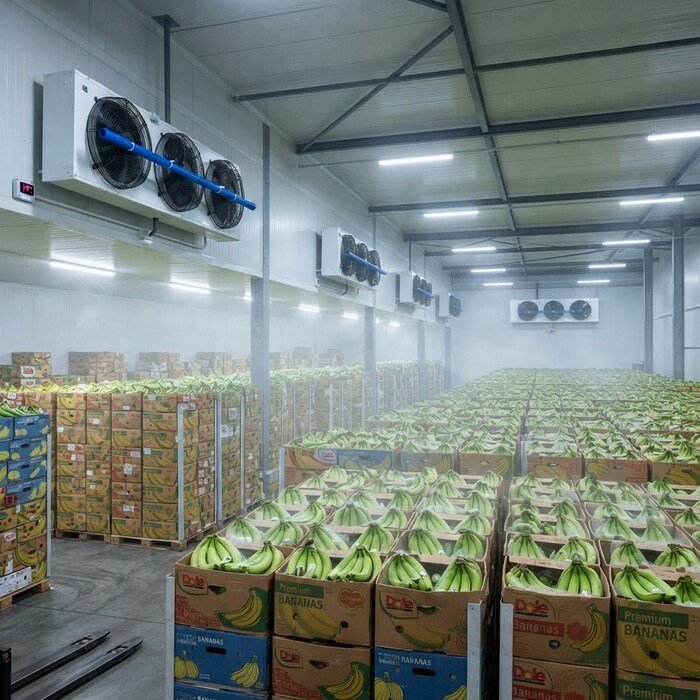
A cold room or warehouse may contain hundreds or thousands of pounds of bananas, or a refrigerated truck may transport a similar amount.
A small household packet is not an appropriate method for managing ethylene in environments of this size.
Commercial applications may utilize larger ethylene absorber filter/tube units installed based upon the characteristics of the storage environment (airflow patterns) and location.
Examples of typical commercial applications include:
- Cold Rooms
- Warehouses
- Refrigerated Trucks
- Reefer Containers
- Distribution Centers
- Storage Areas At Grocery Stores
Determining the amount of absorber needed cannot be accomplished solely through stating “X grams per kilogram of bananas.”
A 20 m³ storage facility filled with green bananas for a brief period is significantly different than a large cold room containing fruit at varying levels of maturity.
Factors including:
- Room volume
- Quantity of fruit present
- Airflow patterns
- Temperature levels
- Length of storage time
- Maturity levels of the fruit present
- Capacity of the absorber
must be taken into consideration.
For additional information regarding the technology itself, please refer to our guide on ethylene filter tubes for fruit storage.
What About Bananas At Home?
The same fundamental issue occurs on a significantly smaller scale in kitchens.
You purchase a bunch of relatively green bananas expecting to consume them over the course of the week.
Within a few days, nearly all of the bananas have ripened simultaneously.
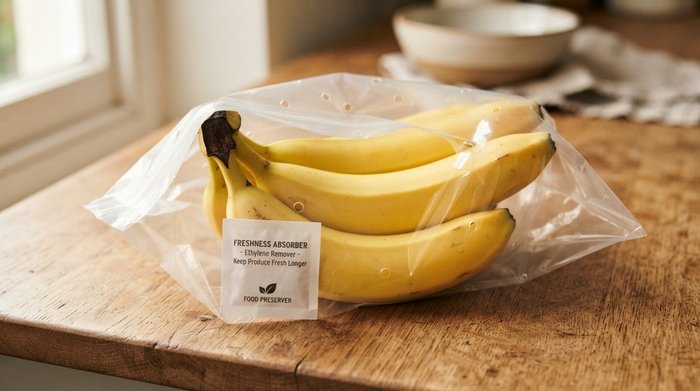
For household consumption, an ethylene absorber sachet may be a more feasible option.
The sachet is placed in the designated area for storing fresh produce and aids in regulating ethylene levels around the produce.
This type of solution may also prove beneficial for other ethylene-sensitive fresh produce being stored nearby.
However, storage habits continue to be relevant.
For instance, if your objective is to extend the ripening process, placing bananas next to other high-ethylene-producing ripe fruit may hinder your efforts.
Commercial Versus Home Banana Storage
| Application | Commercial Storage | Home |
|---|---|---|
| Quantity | Boxes or Pallets | One or Multiple Bunches |
| Solution | Ethylene Filter/Tube | Small Absorber Sachet |
| Environment | Cold Room, Warehouse, Transport | Household Fresh Produce Storage |
| Selection | Based On Storage Conditions | Small-Scale Use |
Can Ethylene Absorbers Extend The Life Span Of Bananas?
Yes, they can aid in managing one of the crucial components contributing to banana ripening; namely ethylene.
Nonetheless, there is no honest response such as “An ethylene absorber will enable each banana to last an additional seven days.”
A green banana stored under controlled conditions will react differently than a banana that has already entered its active ripening phase.
Consequently, commercial users should strive to manage ethylene as part of their overall storage strategy and minimize the probability of bananas ripening prematurely.
Conversely, for household consumers, the concept is far less complicated: assist your bananas (and potentially other fresh produce) in remaining in their desired state for extended periods rather than observing everything ripen at once.
Do you require an ethylene-control solution for banana storage?
Darbune offers ethylene absorber solutions for both commercial fruit storage facilities and household applications within the UAE.