

Most companies invest in new software, employee training, ergonomic chairs, and better office design to improve productivity.
Schools invest in modern classrooms, digital learning tools, and educational programs to help students perform better.
But one investment is often overlooked.
The air people breathe every day.
Employees spend around eight hours a day inside office buildings.
Students spend thousands of hours inside classrooms throughout their education.
If indoor air contains elevated levels of carbon dioxide (CO₂), volatile organic compounds (VOCs), and airborne particles, people may become tired, lose concentration, and make slower decisions without realizing that poor air quality is the cause.
Clean indoor air is no longer just a health issue.
It has become a business advantage.

The Harvard Study That Changed the Conversation
One of the most influential studies on indoor air quality was conducted by researchers from Harvard University.
Twenty-four participants spent six full working days inside a controlled office environment under different indoor air conditions.
Researchers compared conventional office environments with offices that had lower VOC concentrations and better ventilation.
The results surprised many building managers.
Average cognitive scores were 61% higher under Green building conditions and 101% higher under Green+ conditions compared with conventional office conditions.
The researchers also concluded that both VOC concentrations and CO₂ levels independently affected cognitive performance, demonstrating that indoor air quality directly influences how people think and work.
For more information about the study, see the Harvard Cognitive Function Study.

Why Indoor Air Quality Matters
Poor indoor air quality rarely causes immediate illness.
Instead, it gradually affects how people feel and perform throughout the day.
Employees may experience:
- Difficulty concentrating
- Mental fatigue
- Slower decision-making
- Eye irritation
- Headaches
- Reduced productivity
Students may experience similar effects.
- Lower concentration
- Reduced attention
- Lower learning performance
- More difficulty solving problems
When people breathe cleaner air, their brains can perform more efficiently.
This is why improving indoor air quality benefits both offices and classrooms.
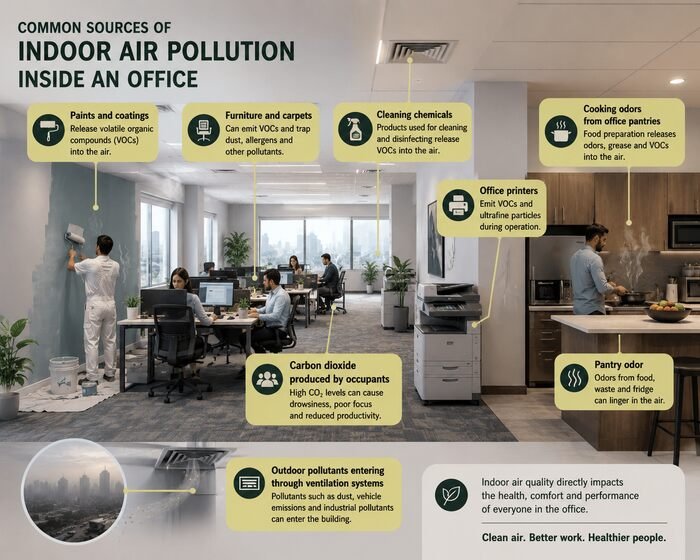
Where Do Indoor Pollutants Come From?
Many people think outdoor pollution is the biggest concern.
In reality, indoor environments have many pollution sources of their own.
Common examples include:
- Paints and coatings
- Furniture and carpets
- Cleaning chemicals
- Office printers
- Cooking odors from office pantries
- Carbon dioxide produced by occupants
- Outdoor pollutants entering through ventilation systems
Many of these sources release volatile organic compounds (VOCs), which can reduce indoor air quality.
Better Air Is an Investment, Not an Expense
Many organizations view air purification equipment as another operational expense.
However, cleaner indoor air should be viewed differently.
Businesses invest in faster computers because employees work more efficiently.
They invest in employee training because better skills improve performance.
Improving indoor air quality follows exactly the same principle.
If cleaner air helps employees concentrate better, make faster decisions, and remain productive throughout the day, then investing in air purification is not simply a maintenance cost.
It is an investment in people.
Even a small increase in employee productivity can easily outweigh the cost of improving indoor air quality.
The same idea applies to schools.
A healthier learning environment can help students stay focused, participate more actively, and achieve better educational outcomes.
If you’re interested in choosing the right solution, you may also find these articles helpful: Ventilation vs Air Purification
Practical Ways to Improve Indoor Air Quality
Improving indoor air quality does not always require major renovations.
Simple improvements can make a meaningful difference.
These include:
- Increasing fresh air ventilation where appropriate
- Reducing VOC emissions during renovation projects
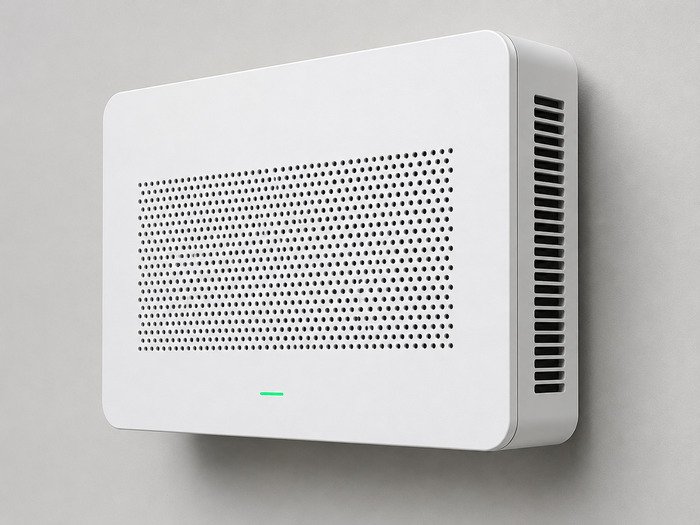
- Using effective air purification systems
- Maintaining HVAC filters regularly
- Removing odor-causing gases instead of masking them
- Monitoring indoor air quality over time
Every building is different, so the most effective solution depends on the building size, occupancy, and pollution sources.
Clean Air Benefits Schools Too
The importance of clean indoor air extends beyond offices.
Students spend a significant portion of their day inside classrooms.
When classroom air contains high levels of CO₂ or VOCs, students may find it harder to concentrate and stay engaged.
Creating healthier classrooms benefits both students and teachers by supporting better learning conditions throughout the school day.

Conclusion
Clean indoor air is no longer just about comfort.
It influences health.
It influences productivity.
It influences learning.
Scientific research continues to show that cleaner indoor air helps people think more clearly and perform better.
For businesses, investing in better indoor air quality is an investment in employee performance and long-term productivity.
For schools, it is an investment in better learning outcomes.
If you’re looking for practical ways to improve indoor air quality in your office, school, or commercial building, explore our indoor air quality solutions or contact the Darbune team to find the right solution for your environment.