Volatile Organic Compounds, commonly known as VOCs, are gases released from many products and materials used in homes, offices, commercial buildings and industrial facilities.
Paints, coatings, solvents, adhesives, cleaning chemicals, furniture and building materials can all release VOCs into the air.
This becomes particularly important during activities such as painting, renovation and fit-out work, where VOC concentrations and strong chemical odors may increase inside a building.
According to the U.S. Environmental Protection Agency (EPA), concentrations of many VOCs can be higher indoors than outdoors. This makes VOC control an important part of maintaining good indoor air quality.

What Are VOCs?
VOCs are organic compounds that can evaporate into the air under normal conditions.
Common sources include:
Paints and coatings
Paint thinners and solvents
Adhesives and glues
Cleaning products
Building materials
Furniture and MDF
Printing processes
Fuels and petroleum products
Dry-cleaning chemicals
Industrial manufacturing processes
The EPA identifies paints, cleaning supplies, building materials, furnishings, office equipment, adhesives and many other products as potential sources of VOCs.
Not all VOCs have the same properties or health risks. Some have strong odors, while others may be present without producing an obvious smell.
This is why removing an odor does not necessarily mean that all VOCs have been removed from the air.
What Are the Health Effects of VOC Exposure?
The effects of VOC exposure depend on the specific chemical, its concentration and how long a person is exposed.
According to the EPA, exposure to some VOCs may be associated with symptoms such as:
Eye, nose and throat irritation
Headaches
Dizziness
Nausea
Respiratory irritation
For certain compounds and exposure conditions, more serious effects involving the liver, kidneys or central nervous system may occur. Some organic compounds are also known or suspected to cause cancer.
This does not mean that every VOC is equally dangerous. Different compounds can have very different toxicity and exposure risks.
For workplaces where paints, solvents or chemicals are frequently used, controlling VOC exposure can therefore be an important part of protecting indoor air quality.
How Do VOCs Affect the Environment?
VOCs are not only an indoor air quality issue.
Many reactive VOCs can participate in atmospheric chemical reactions. In the presence of nitrogen oxides (NOx) and sunlight, they can contribute to the formation of ground-level ozone, an important component of photochemical smog.
The EPA identifies industrial coating operations, printing shops, paints, gasoline dispensing and household chemicals among the sources of VOC emissions.
Reducing unnecessary VOC emissions can therefore benefit both indoor environments and outdoor air quality.
×

Why Does Paint Smell After Painting?
One of the most familiar examples of VOC emissions is the smell experienced during and after painting.
Paints, primers, coatings and related products may release volatile chemicals as they are applied and dry.
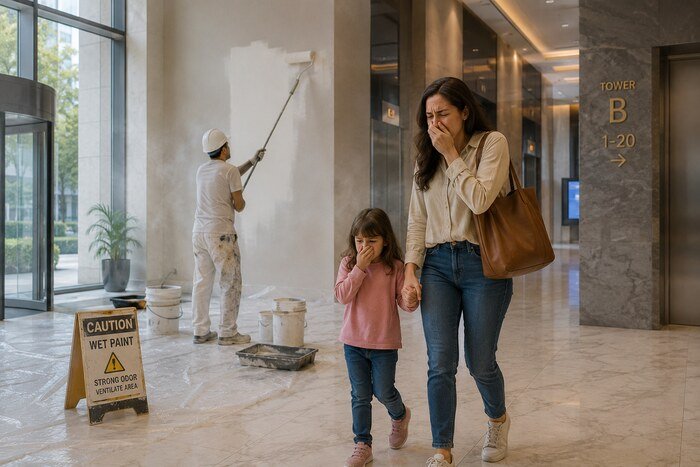
This can become particularly noticeable in apartments, hotels, offices, towers and other occupied buildings, where painting or maintenance work may take place while other areas remain operational.
Paint odors can spread from the work area into corridors, lobbies or neighbouring spaces.
For Facility Management teams, reducing these odors quickly can improve comfort for residents, employees and visitors.
How Can Paint VOCs and Odors Be Reduced?
The first step should always be source control and proper ventilation.
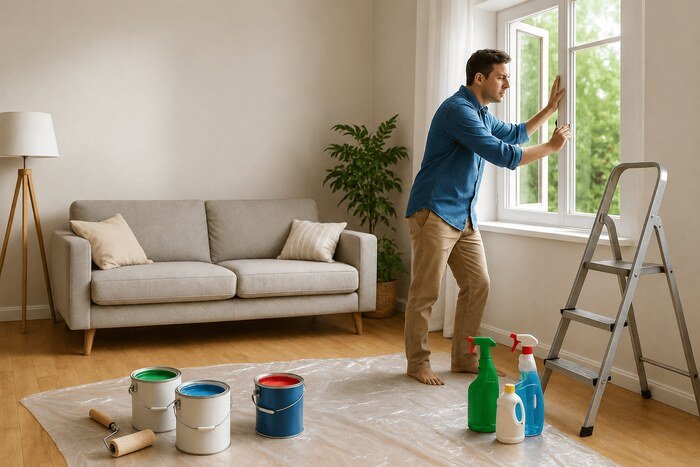
The EPA recommends providing plenty of fresh air and ventilation when painting or remodeling.
However, ventilation may not always be sufficient or practical, especially in enclosed or air-conditioned buildings.
This is where air filtration using activated carbon can become useful.
Activated carbon contains a highly porous internal structure capable of adsorbing many gaseous contaminants and odor molecules.
Unlike HEPA filters, which are primarily designed to capture particles, activated carbon is used for gas-phase filtration.
For stronger VOC applications, a substantial activated-carbon bed or cartridge is generally more appropriate than a very thin carbon sheet.
Portable VOC and Odor Air Scrubbers
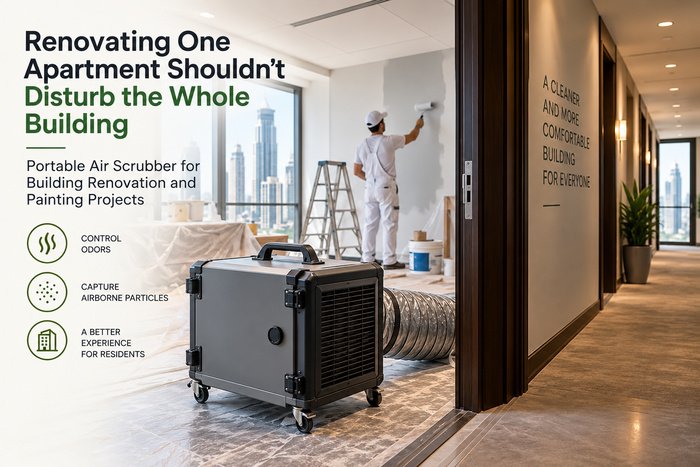
A practical solution for Facility Management teams can be a Portable VOC & Odor Air Scrubber.
The system can be moved to areas where painting, renovation or maintenance work is taking place.
A typical configuration may include:
Pre-filter → Activated Carbon Filter → Fan → Treated Air
Depending on the application, additional particulate filtration may also be included.
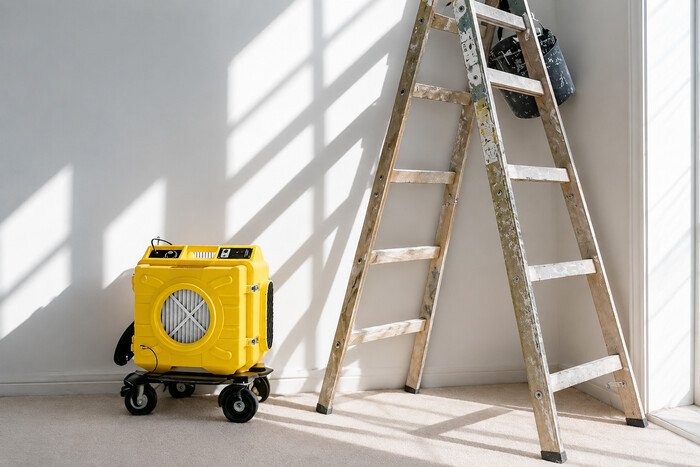
Such equipment could be useful for:
Residential towers
Hotels
Office buildings
Shopping malls
Facility Management companies
Fit-out contractors
Property developers
Renovation companies
Activated Carbon Is Not a Universal VOC Solution
Activated carbon can be highly useful for many VOCs, but it is important to understand its limitations.
Adsorption performance depends on the specific VOC, carbon type, carbon quantity, airflow, humidity, concentration and contact time.
Some VOCs are more difficult to capture with standard activated carbon and may require specially treated adsorption media or another air-treatment technology.
For this reason, professional VOC control should begin by understanding the pollution source rather than simply attempting to cover the smell.
A Better Approach to Indoor Air Quality
Paint odor is only one example of a larger indoor air quality challenge.
Painting, renovation, new furniture, adhesives, cleaning chemicals and building materials can all introduce volatile compounds into indoor environments.
The better approach is therefore:
Identify the source → Improve ventilation → Capture appropriate VOCs → Monitor air quality
At Darbune, we believe odor and air pollution should be addressed at their source rather than simply masked with fragrances.
Modern air-treatment solutions using technologies such as activated carbon can help buildings, businesses and Facility Management teams create cleaner and more comfortable indoor environments.