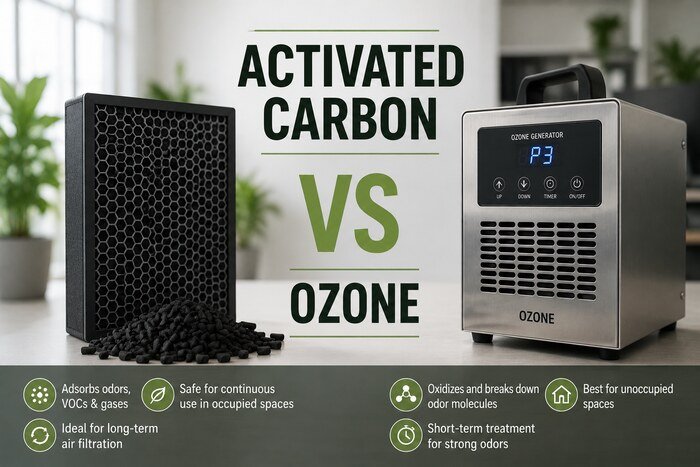
When people look for a solution to remove bad odors, they often come across two popular technologies: activated carbon and ozone.
At first glance, they may seem to do the same job. Both are used to reduce odors, improve indoor air quality, and control unwanted smells. However, they work in completely different ways and are designed for different applications.
Choosing the wrong technology can lead to poor results—and in some situations, unnecessary health risks.
Understanding the difference between activated carbon and ozone helps homeowners, businesses, and facility managers choose the right solution for their environment.
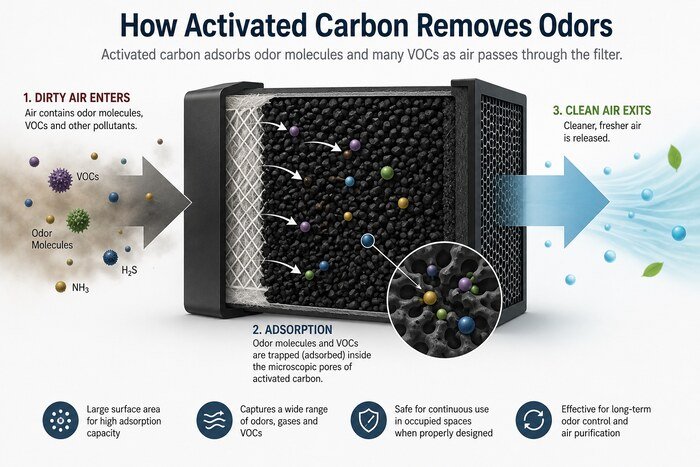
How Activated Carbon Removes Odors
Activated carbon is one of the most widely used filtration materials for removing odors and gases.
Instead of covering up smells with fragrance, activated carbon adsorbs odor molecules inside millions of microscopic pores on its surface. As contaminated air passes through the filter, many odor-causing gases and VOCs become trapped inside the carbon.
Because activated carbon does not release chemicals into the air, it is commonly used for continuous odor control in occupied buildings.
Typical applications include:
- Offices
- Homes
- Restaurants
- Hotels
- Commercial buildings
- Pet areas
- Kitchen odor control
- Air purification systems
How Ozone Removes Odors
Ozone works in a completely different way.
Instead of trapping odor molecules, ozone is a highly reactive gas that oxidizes many odor-causing compounds. During this chemical reaction, some odor molecules are broken down into different substances.
Because ozone reacts with many materials in the air, it can also react with fabrics, rubber, plastics, artwork, and other indoor materials over time.
Ozone can be effective for certain applications such as smoke damage restoration, fire restoration, and some remediation projects.
However, this does not mean it is the best solution for everyday indoor air purification.
Why Ozone Should Not Be Used Everywhere
One of the biggest misconceptions is that ozone generators can safely run all day inside occupied spaces.
In reality, ozone itself is an air pollutant.
Breathing elevated concentrations of ozone may irritate the eyes, nose, throat, and lungs. People with asthma and other respiratory conditions may be especially sensitive.
For this reason, ozone treatment is generally performed only in unoccupied spaces, followed by adequate ventilation before people return.
Using ozone continuously in occupied offices, apartments, schools, hotels, or restaurants is generally not recommended.
read more about ozone generator : U.S. EPA – Ozone Generators That Are Sold as Air Cleaners
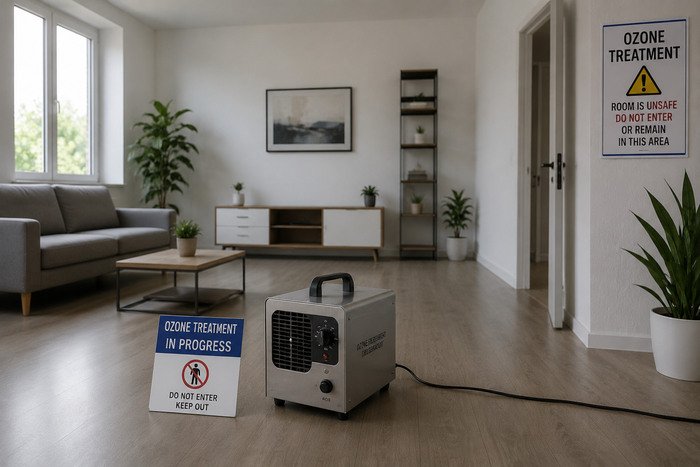
Activated Carbon vs Ozone
Although both technologies help control odors, they are designed for different purposes.
Activated carbon is best suited for continuous filtration where people are present. It quietly removes many odor-causing gases and VOCs without releasing reactive gases into the environment.
Ozone is better suited for specialized restoration projects where people are not inside the treated area.
Rather than asking which technology is better, a better question is:
Which technology is appropriate for this situation?
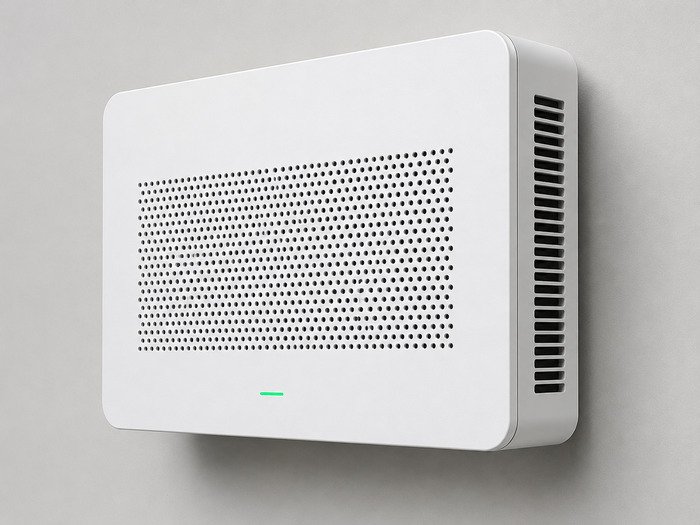
Which Solution Should You Choose?
If your goal is to continuously control odors in occupied indoor environments, activated carbon filtration is generally the more appropriate solution.
Examples include:
- Office odor removal
- Kitchen odor control
- Pantry odors
- Pet odors
- Corridor odors
- Restaurant odors
- VOC reduction during normal building operation
On the other hand, if the building is empty and professional odor remediation is required after fire or smoke damage, ozone treatment may be considered by trained professionals following appropriate safety procedures.
The two technologies are not competitors.
They solve different problems.
Conclusion
Activated carbon and ozone both have important roles in odor control, but they should not be used interchangeably.
Activated carbon is designed for continuous filtration and long-term odor control in occupied environments, making it an excellent choice for offices, homes, schools, hotels, and commercial buildings.
Ozone is a powerful oxidation technology that is better suited for specific restoration applications in unoccupied spaces and should always be used with appropriate safety precautions.
Understanding the strengths and limitations of each technology helps you choose the safest, most effective, and most practical solution for your indoor environment.
If you’re looking for a long-term solution for indoor odor control, contact Darbune to find the right filtration system for your building or business.