A pleasant smell can make a home, office, or car feel cleaner. But a fresh fragrance does not necessarily mean the air itself is clean.
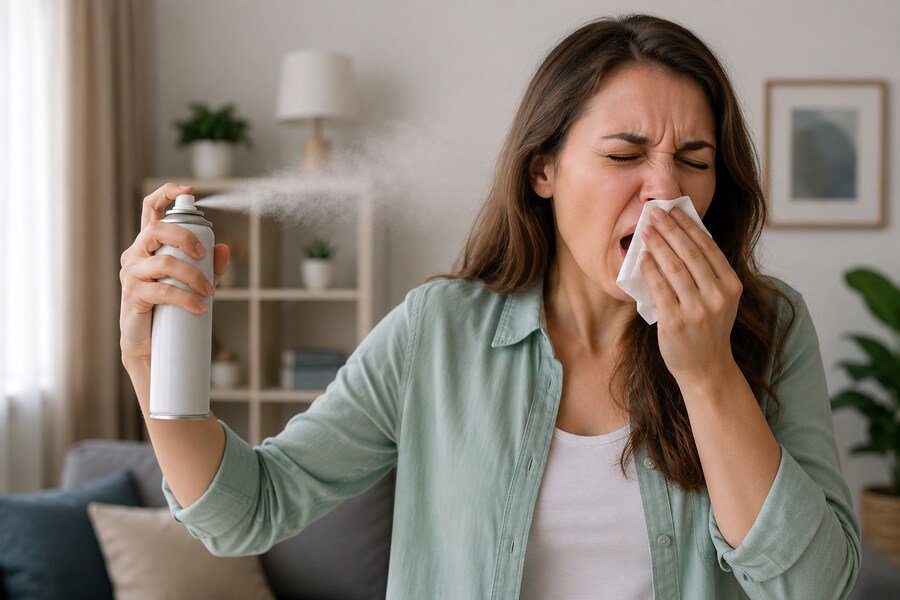
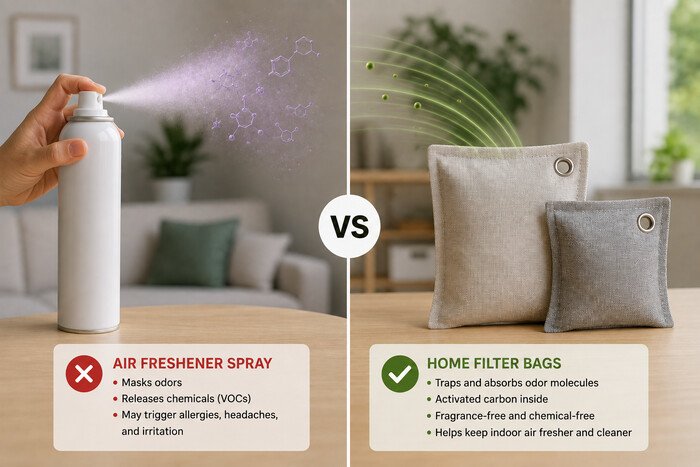
Air freshener sprays are designed mainly to add fragrance or mask unpleasant odors. When sprayed indoors, they can release chemicals into the air, including volatile organic compounds (VOCs). For most people, occasional exposure may not cause noticeable problems, but people with allergies, asthma, migraines, or chemical sensitivities may experience symptoms after exposure to fragranced products. The American Lung Association lists headaches, dizziness, eye, nose and throat irritation, coughing, wheezing, nausea, and shortness of breath among possible symptoms. (Lung Association)
For people who repeatedly experience symptoms around perfumes, air fresheners, or scented cleaning products, reducing fragrance exposure can be an important part of improving indoor air quality.
What Is Actually Released When You Spray an Air Freshener?
Air fresheners are not simply “pleasant smells in a bottle.”
Fragrance formulations can contain numerous chemicals, including VOCs that evaporate easily at room temperature. Research has identified compounds such as limonene, aldehydes, esters and other volatile substances in air-freshener emissions. The exact mixture varies considerably between products. (HERO)
Limonene, for example, is commonly used to create citrus-like fragrances.
An additional concern is what happens after some fragrance chemicals enter indoor air. Certain terpenes, including limonene, can react with ozone and contribute to secondary pollutants such as formaldehyde and fine or ultrafine particles.
The U.S. EPA also notes that VOC concentrations for many compounds can be higher indoors than outdoors and that household products, including air fresheners, are among indoor VOC sources. (US EPA)
Is It an Allergy or Sensitivity to Fragrance?
Not every reaction to an air freshener is technically an allergic reaction.
Fragrances may cause irritation, trigger asthma, provoke headaches or migraines, or cause symptoms in chemically sensitive individuals without necessarily involving a classic allergic immune response. The EPA notes that the mechanisms behind fragrance-related symptoms remain an area of scientific discussion, although sensitive individuals can experience asthma episodes and other adverse effects following exposure.
Common symptoms can include:
- Sneezing or a runny nose
- Burning or irritated eyes
- Nose and throat irritation
- Headache or migraine
- Coughing
- Wheezing
- Shortness of breath
- Dizziness or nausea
If symptoms are severe, persistent, or include difficulty breathing, medical evaluation is important rather than assuming that fragrance is the only cause.

Children and Air Fresheners
Children deserve particular attention because their respiratory systems are still developing and they breathe more air relative to their body size than adults.
The EPA specifically recommends keeping children and other sensitive people away when products containing chemical irritants are being used. It also notes that some air fresheners and fragranced products may exacerbate asthma. (US EPA)
In homes with children who have asthma or respiratory sensitivities, reducing unnecessary fragranced products is a sensible precaution.
What About Pregnancy, Older Adults and Pets?
Pregnancy is another good reason to minimize unnecessary chemical exposure rather than assuming that every fragranced product is harmless. The American Lung Association includes pregnant people among groups that may be more vulnerable to fragrances. (Lung Association)
Older adults, particularly those with asthma, COPD, allergies or other respiratory conditions, may also be more sensitive to indoor pollutants and strong fragrances.
Pets add another consideration. Dogs, cats, birds and other animals share the same indoor air but have different respiratory and metabolic sensitivities. Rather than routinely spraying fragrances around pets, a safer general approach is to remove the odor source and ventilate the space. For specific pet exposures or symptoms, veterinary advice is appropriate.

Masking an Odor Is Not the Same as Removing It
This is perhaps the most important point.
If your kitchen smells after cooking, your pet area develops an odor, or your office pantry smells after lunch, spraying another fragrance into the room does not remove the original odor source.
It adds another substance to the air.
A better odor-control strategy follows three steps:
- Remove or clean the source whenever possible.
- Improve ventilation where appropriate.
- Capture remaining airborne odor molecules instead of masking them.
For gaseous pollutants and odors, filters containing sorbent media such as activated carbon can be useful. The EPA notes that ordinary particle filters do not remove gaseous pollutants unless they contain special media such as activated carbon or alumina.
A Fragrance-Free Approach to Odor Control
Darbune odor-control filters use adsorption media such as activated carbon to capture odor-causing molecules rather than adding perfume to indoor air.
This makes passive or filtered adsorption particularly attractive for homes, offices, shoe cabinets, pantries, waste areas and other spaces where people want to control odors without continuously introducing fragrances.
It is important, however, not to describe any filtration system as 100% risk-free or as a treatment for allergies. Filter performance depends on the media, amount of carbon, airflow, pollutant, contact time and replacement schedule.
The objective is simpler: remove the source where possible and capture odors rather than covering them with another smell.
Cleaner Air Does Not Need to Smell Like Anything
We often associate lemon, lavender or floral fragrances with cleanliness.
But truly clean indoor air does not need a fragrance.
If air fresheners regularly make you sneeze, cough, develop headaches, or experience irritation, consider reducing fragranced products and identifying the actual odor source. Choose fragrance-free products, ventilate appropriately, and use suitable filtration when odors or gaseous pollutants remain. These steps are also consistent with recommendations from the American Lung Association for reducing fragrance exposure. (Lung Association)
If you are looking for a fragrance-free way to control persistent odors, contact Darbune to learn more about activated-carbon odor filtration solutions for homes, offices and shared indoor spaces.